
Innovation model
inaglobe's innovation model challenges prevailing paradigms that prioritise scalability and profitability over social impact. We treat projects as situated experiments rather than products to scale at all costs—placing inclusivity and sustainability at the heart of innovation work.
Drawing inspiration from impactful innovations like M‑Pesa and the mobile technology boom in Africa, our approach recognises that technology can address real needs when developed in close relationship with communities. By involving end‑users and stakeholders from the outset, we ensure solutions are not only technologically sound but also socially and environmentally responsible.
Challenging current innovation paradigms
Prevailing paradigms in technology innovation are driven by a market‑centric approach, prioritising products that promise high returns and scalability. This approach, while successful in driving economic growth, often neglects the needs and contexts of marginalised communities and the environment, leaving behind a sizeable portion of the global population and contributing to ecological degradation.
Traditional approach
- Market‑centric, prioritising financial returns
- Focus on scalability and rapid growth
- Technology‑driven, often disconnected from user needs
- Short‑term horizons and exit strategies
inaglobe approach
- Social impact and sustainability at the core
- Treats projects as situated experiments
- User and context‑centred from the start
- Long‑term relationships and patient capital
The innovation process
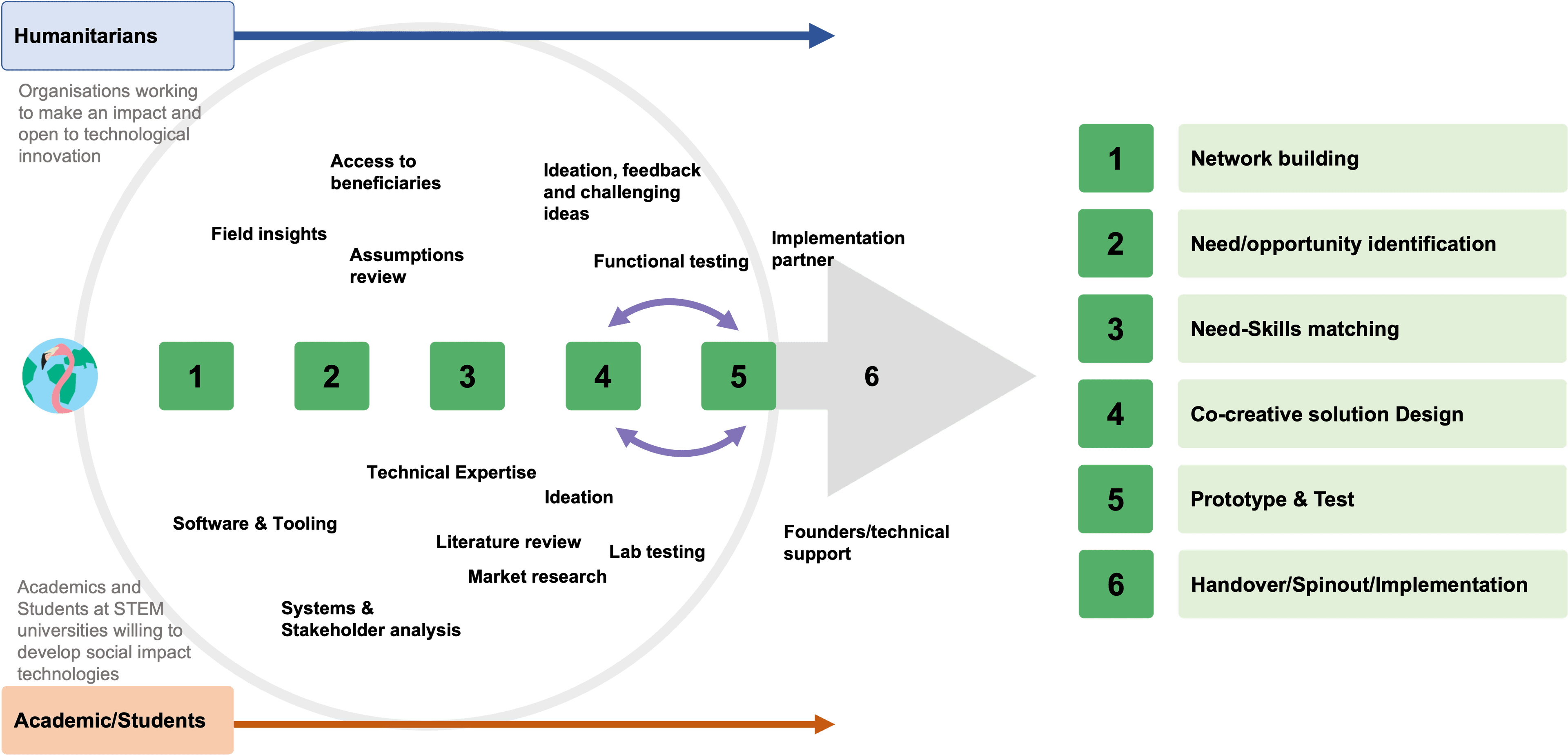
Students move between inquiry, making, and sharing—testing ideas with partners and adapting to local conditions. This iterative process treats innovation as an ongoing, relational practice rather than a linear pipeline from idea to product.
Enquire
Projects begin with listening, ethnographic work, and systems mapping. Students work with partners to define questions rather than jump straight to solutions. This stage involves:
- Deep listening and relationship building
- Ethnographic research and context mapping
- Systems thinking and complexity analysis
- Co‑defining questions with partners
Experiment
Teams move between low‑fi prototypes, simulations, and small field tests, using frugal and accessible methods that fit local constraints. This stage emphasises:
- Rapid, low‑cost prototyping
- Field testing in real contexts
- Frugal innovation and resource constraints
- Iterative refinement with partner feedback
Reflect & share
Outcomes—successful or not—are documented, shared with partners, and added to the open resource so others can learn from them. This stage includes:
- Documentation of process and outcomes
- Reflection on what worked and what didn't
- Sharing with partners and wider network
- Contributing to the open resource
Core principles
Our innovation model is guided by principles that ensure work is socially responsible, contextually appropriate, and environmentally sustainable:
Problem‑ and user‑centred
Work starts from lived realities and co‑defined questions, not from technologies in search of a use. We begin with understanding the context, needs, and constraints of partners and communities, ensuring that solutions emerge from real problems rather than predetermined technical solutions.
Open and reflective
Process, failures, and partial results are documented and shared to support others working on similar issues. This openness enables collective learning and prevents repeating mistakes, while building a shared knowledge base that grows over time.
Frugal and context‑aware
Solutions are evaluated in terms of maintenance, energy use, governance, and social fit—not just novelty. We consider the full lifecycle of innovations, asking: Who will maintain this? How much energy does it require? What governance structures support it? How does it fit into existing social and cultural practices?
Inclusive and sustainable
By involving end‑users and stakeholders from the outset, we ensure solutions are technologically sound, socially responsible, and environmentally conscious. This aligns with global calls for innovations that are accessible to all layers of society and contribute to a sustainable future.
Frugal innovation and resource constraints
Drawing on the frugal innovation movement, inaglobe recognises the power of resource‑constrained innovation to create affordable and sustainable solutions that serve the needs of the many, not just the few. Our projects often operate with minimal capital, emphasising ingenuity over expense and fostering a culture of innovation driven by necessity.
This constraint, while limiting in some ways, also leads to creative solutions that are both cost‑effective and socially impactful. By working within existing budgets and resource constraints, we develop innovations that are more likely to be maintained, adapted, and extended by communities over time.
How this connects
The innovation model works in tandem with our pedagogical model to create learning experiences that are situated, relational, and justice‑oriented. Together, they operationalise our mission and vision of shifting innovation paradigms toward inclusivity and sustainability.
For more on how we work with students, partners, and educational institutions, see How we work. Tools, methods, and case studies from our innovation practice are documented in the inaglobe open resource.